More than three million passengers on ferries and cruise vessels
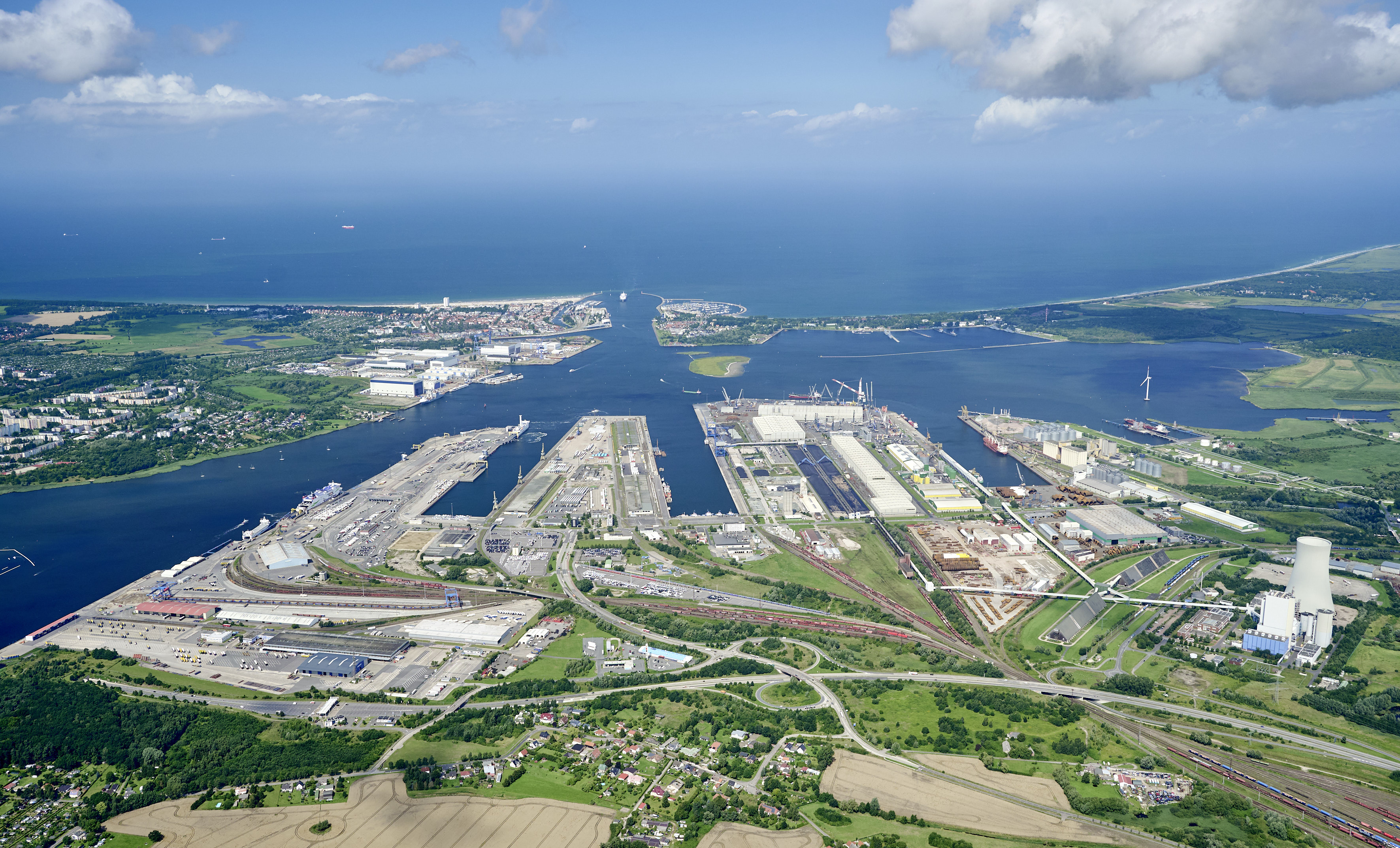
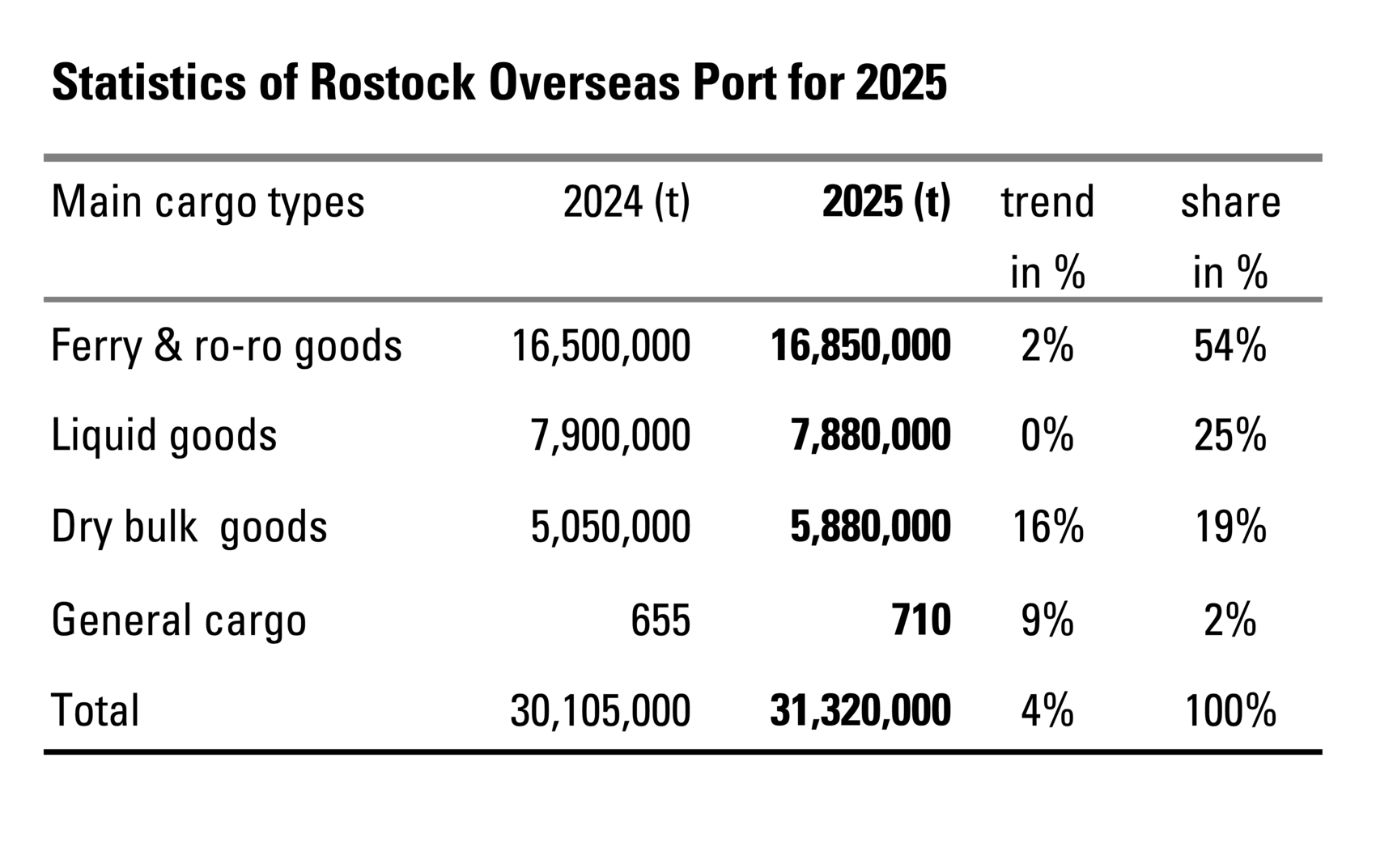
Once again and thus for the third consecutive year, cargo handling at Rostock Overseas Port exceeded 30 million tonnes. „At 31.3 million tonnes of cargo a new handling record was scored and last year’s result was exceeded by four percent”, states Dr. Gernot Tesch, managing director of the port operator ROSTOCK PORT. „The 2025 handling result confirms the efficiency of the companies and public authorities operating at the largest universal port on the German Baltic Sea coast. The port of Rostock is an economic beacon for the city and the federal state”.
According to Rostock’s Port and Shipping Authority the other ports in Rostock, such as the cargo and fishing port and the chemical port, together handled another 1.8 million tonnes of goods in 2025. Thus a total of 33.1 million tonnes of cargo were transhipped in the port city of Rostock last year.
„Last year we had the pleasure to welcome a total of 3.2 million passengers on the ferries and cruise vessels at the Overseas Port and in Warnemünde, which is around 100,000 travellers more than in the previous year“, summarises Jens Scharner, managing director of ROSTOCK PORT GmbH. „At 2.6 million passengers on the three ferry services to Denmark and Sweden operated by Scandlines, Stena Line and TT-Line there was a rise of 30,000 ferry passengers over the previous year. At the Warnemünde cruise port 592,000 passengers embarked and disembarked (2024: 532,000) during 165 port calls (2024: 148) by 35 cruise vessels (2024: 37). On 126 out of 365 days of the year 2025, cruise liners from 23 national and international shipping companies were moored in Warnemünde cruise port.”
In the year 2025, around 33 million Euros were invested in the infrastructure of the Overseas Port. This year, ROSTOCK PORT plans on investing more than Euro 60 million.
Cargo handling results at the Overseas Port
„Despite the continuing weak economy this new handling record in Rostock speaks in favour of the transport corridors and logistics chains successfully established over many years while also demonstrating the efficient logistics of the location. Clearly this is a joint success of the entire port cluster in Rostock”, says Dr. Gernot Tesch.
All told, Rostock Overseas Port logged 7,580 port calls by ferry and ro-ro vessels, tankers, freighters and cruise liners last year (2024: 7,577), of which 5,850 port calls were made by ferry and ro-ro vessels (2024: 5,857).
Dry bulk handling was 16 percent above the previous year with a total of 5.9 million tonnes. Growth was recorded both in building materials, fertilizer, coal, animal feed and in oil seeds. With an annual result of 2.4 million tonnes grain remains the dominant dry bulk cargo at the Overseas Port despite some declines.
At 7.9 million tonnes the handling of liquid goods reached the previous year’s high result. Nearly six million tonnes of crude oil were pumped from tankers via Rostock Oil Port into the pipeline to the PCK refinery in Schwedt as a contribution to securing the supply of petrol station products to eastern Germany.
At 711,000 tonnes handling of general cargo was about 56,000 tonnes above the level of the previous year. There were high growth rates in the handling of wind power plants and blades, cranes and zinc.
In the field of wheeled cargo, i.e. ferry and ro-ro goods, the port managed to step up the level of the previous year by 350,000 tonnes from 16.5 million tonnes to 16.85 million tonnes despite the weak economy. The number of truck/trailer units carried on the ferry and ro-ro connections to and from Northern Europe increased by 11,000 to 528,000 units. In a difficult market environment the handling of paper increased by remarkable 144,000 tonnes to 522,000 tonnes.
Ferry travel continued to increase also last year. The number of cars and mobile homes carried between Northern Europe and Rostock amounted to 660,000. The number of railway wagons carried to and from Trelleborg decreased mainly on account of building sites, from 21,800 in 2024 to 20,000 last year.
The approach of ROSTOCK PORT to widen its range by establishing a port terminal for car handling has proven to have a stabilising and growth-inducing effect for ferry and ro-ro traffic. The import and export of new cars increased especially by the establishment of the automotive logistics company Autolink, from 122,000 in 2024 (2023: 32,000) to 132,000 vehicles last year.
The share of wheeled cargo in the overall handling at Rostock Overseas Port was 54 percent. The well-balanced spread between the handling of wheeled cargo and dry bulk, liquid and general cargo is a trademark of the all-purpose port.
Intermodal transport on a steady level
Contrary to market trends in other rail freight segments the handling of intermodal transport units was on a stable level. The terminal operator Rostock Trimodal (RTM) transhipped around 110,000 units last year. „Intermodal transport thus remains a reliable mode of transport and nearly reaches last year’s result despite the difficult economic environment continuing unchanged and in spite of higher train path prices as well as a large number of building sites all over the German rail network (2024: 112,000 load units). „In the medium and long term we continue to take a positive view of the growing demand for intermodal solutions and have begun to expand the necessary capabilities at the port accordingly”, says Dr. Gernot Tesch. The five railway tracks currently in place underneath the gantry cranes will be extended to a craneable length of 680 metres each until the second quarter of 2026.
As of the annual change of timetable in December there are now 49 intermodal trains per week to and from Verona (19) and Padua (8) in Italy, Bratislava (5) in Slovakia, Oradea (2) in Romania as well as Karlsruhe (3), Dresden (5), Herne (6) and Halle (1) in Germany. In addition, higher departure frequencies are expected on individual services in the first six months of the year.
Projects and investments
Track extension at the intermodal transport terminal
Building work to extend the railway tracks at the intermodal transport terminal to 680 metres began in the spring of 2025. Apart from the extension of the tracks a major part of this building project is the extension of the crane track spar with railway facilities for the gantry cranes. This construction work is taking place with the terminal continuing in full operation.
„Rostock is confident that thanks to its above-average railway infrastructure, but also as a result of targeted measures to extend capacity combined with ongoing investment by DB InfraGo (formerly DB Netz) it will be able to contribute to the establishment of green transport chains and to the transfer of traffic from road to rail“, explains Dr. Gernot Tesch.
EU subsidy programme „Rail-IT-MoS“
As part of the EU subsidy programme „Rail-IT-MoS“, which comprised a total investment volume of roughly seven million Euros over the entire project span from 2023 to 2025 at Rostock Overseas Port, ROSTOCK PORT has completed the refurbishment of railway and switching facilities at the ferry and ro-ro terminal.
Furthermore, a new elevator facility was installed and commissioned at berth 64 in order to improve ferry passenger traffic. This has vastly improved accessibility of the Stena Line railway ferries operating between Rostock and Trelleborg, ensuring barrier-free travel.
Another sub-measure aimed at extending and optimising areas west of quay shed 9a was the completion of asphalting work on an area covering approx. 7,000 square metres within the ro-ro terminal. Two new floodlight masts have been installed as well. Furthermore, the ro-ro ramp at berth 62 was widened from 28 to 31 metres. Also, the construction of additional pile dolphins is planned at berth 63 until the summer of 2026.
In order to extend and improve the information and communications technologies at the Overseas Port, an upgrade was performed on the north gate to allow for automatic check-in and check-out of trucks and trailers which was combined with integrated network technology (Wireless Local Area Network - WLAN and Wireless Wide Area Network - WWAN) at the ferry and ro-ro terminal.
Demolition of gangway facility
At the ferry terminal, demolition of the old gangway facility at berth 67 was begun. It has been out of operation for years and does not serve any purpose now. Comprehensive measures for the protection of endangered species were undertaken before the demolition.
Traffic infrastructure upgrade south of port basin A
As part of phase 2 of the funding plan to improve the traffic infrastructure, extensive demolition work was begun still last year south of port basin A, clearing old storage sheds on an area of around ten hectares. This demolition work is expected to be completed in three stages by the end of 2026 and is being accompanied by extensive measures to protect endangered species.
After they have been cleared these areas, which adjoin the ferry and ro-ro terminal, will be available for further port development. This whole project also receives funding from the joint Federal Government/Länder scheme for improving regional economic infrastructure. The overall volume of the project amounts to roughly 15 million Euros.
New building of berths 33 and 34
The building contract for the new-building of berths 33 and 34 was awarded just over a year ago. This means that the last two berths from the 1960s on the east side of pier 2 will be completely rebuilt on a length of about 400 metres. With a draught of 12.50 metres and a surface load carrying capacity of five tonnes per square metre the construction parameters of these berths will more or less coincide with those of the newly built berths 31 and 32.
Construction will take about two years and is estimated to cost just under 20 million Euros. The project is subsidised by the federal state of Mecklenburg-Vorpommern under the joint Federal Government/Länder scheme for improving regional economic infrastructure. It will be completed in 2026.
Replacement of the crane track at berth 24
Over the course of several construction stages ROSTOCK PORT is spending 2 million Euros on replacing the crane track at berth 24. The work will be completed next year.
New building of deep-water berth 5 at the Oil Port
In June 2022 an order was placed for the planning of a deep-water berth in the eastern part of Rostock Oil Port. The aim is to obtain a building permit as quickly as possible on the basis of a qualified and accelerated planning effort in order to upgrade berth 5 for future energy imports and allow for sufficient amounts of sustainable energies to be reliably provided via Rostock. „The approval procedure is currently being prepared in close cooperation with the authority issuing the zoning approval at the Ministry of Economics of Mecklenburg-Vorpommern and will shortly be started officially. Construction is to start in 2026”, explains Jens Scharner.
Construction is estimated to take around two years. After completion the port basin at the Oil Port will be connected to the turning basin at the same draught as the turning basin, i.e. 16.50 metres. Since the building work will predominantly take place within the existing port basin, interference with nature can be limited to a minimum.
Upgrade of the fender facilities of berth 3 at the Oil Port
Since 2023 berth 3 at the Oil Port has been in unusually intense and constant use for supplies to the PCK refinery at Schwedt. Work on upgrading the fender facilities was conducted while shipping operations continued so that the intense transhipment activities were able to proceed uninterrupted. The project cost around 1.4 million Euros.
Provision of areas for port development / development plan for area 34
The demand for areas adjoining the quays continues to exceed the land on offer by far. Currently the development plan is being prepared for one of the last sizeable areas in the special area of the port, area 34, which is located between the oil port and the chemical port. The successful establishments of businesses to date and the extension projects pursued by numerous companies established at the port were only possible thanks to forward-looking measures creating land reserves in the past. From the point of view of port development these reserve areas have been almost used up.
In view of the current challenges and opportunities, especially those connected with the energy transition and the transformation of large parts of industry it is indispensible to step up the provision of areas in and around the port. This is the only way to secure the long-term development of the port. At the moment this is happening by the Planning Association of Rostock reconfiguring the regional spatial development programme (RREP), which is to identify extension options in the shape of priority areas located east and west of the port.
In the by now second draft of this document a compromise has been worked out together with the Planning Association, the Hanseatic and University City of Rostock, the environmental associations and ROSTOCK PORT. It does include considerable business challenges for an efficient use of the port but represents a step in the right direction despite the constraints. „Now this step has to be confirmed as soon as possible in the final wording of the spatial development programme, working in slight adjustments for a more functional port layout and quickly adopting these without limitations while reconfiguring the zoning plan of the Hanseatic and University City of Rostock. We will continue to provide assistance on content and communicate with our partners in order to move this process forward”, says Jens Scharner.
Energy port Rostock: Hydrogen production project and import of sources of green energy
In line with its sustainability strategy, ROSTOCK PORT promotes decarbonisation projects as well as new business models in the fields of hydrogen and the import of green derivatives. These activities are an important step on the way to achieving climate neutrality at the site.
„Our strategic projects comprise an interest in rostock EnergyPort cooperation GmbH, the upgrading of our infrastructure for sources of green energy, the new building of berth 5 as well as the provision of land for the import and storage of renewable energy sources”, says Jens Scharner. „By doing so we are striving to become a forerunner as an energy hub for the distribution of hydrogen in order to sustainably reduce carbon dioxide emissions and environmental pollution.”
2026 cruise shipping season starts with AIDAdiva
„The arrival of AIDAdiva on 29 March will ring in the 2026 cruise shipping season in Warnemünde. 20 cruise shipping companies from Germany and abroad have so far notified 162 port calls by 35 cruise liners for this year. Rostock-based shipping company AIDA Cruises will for instance perform 65 port calls with changes of passengers at its home port of Warnemünde with AIDAdiva and AIDAmar”, says Dr. Gernot Tesch.
Three cruise vessels will call at the mouth of river Warnow for the first time this year: Evrima of the shipping company Ritz-Carlton Yacht Collection on 18 July, Scenic Eclipse II of the shipping company Scenic Ocean on 21 August and Seven Seas Grandeur of Regent Seven Seas Cruises on 23 August.
Out of the 162 port calls, 95 have been notified as changing passengers in port and 67 will be transit port calls. The 2026 cruise shipping season is expected to end on 29 December with the port call by Spirit of Adventure of the UK shipping company Saga Cruises.
„2025 has been a successful year for cruise shipping tourism and for the cruise port of Rostock-Warnemünde: 592,000 cruise tourists started their journey in Rostock or visited Rostock and the region during 165 port calls by 35 vessels. During 75 port calls the vessels used clean shore electricity, consuming a total of 2.2 million kilowatt hours. On 126 out of 365 days of the year the port was abuzz with cruise tourism and a living testimony to the role of Warnemünde as a gateway to the Baltic Sea”, summarises Jens Scharner.
PM for Download: as PDF