Baltic Transport Journal 3-4/26
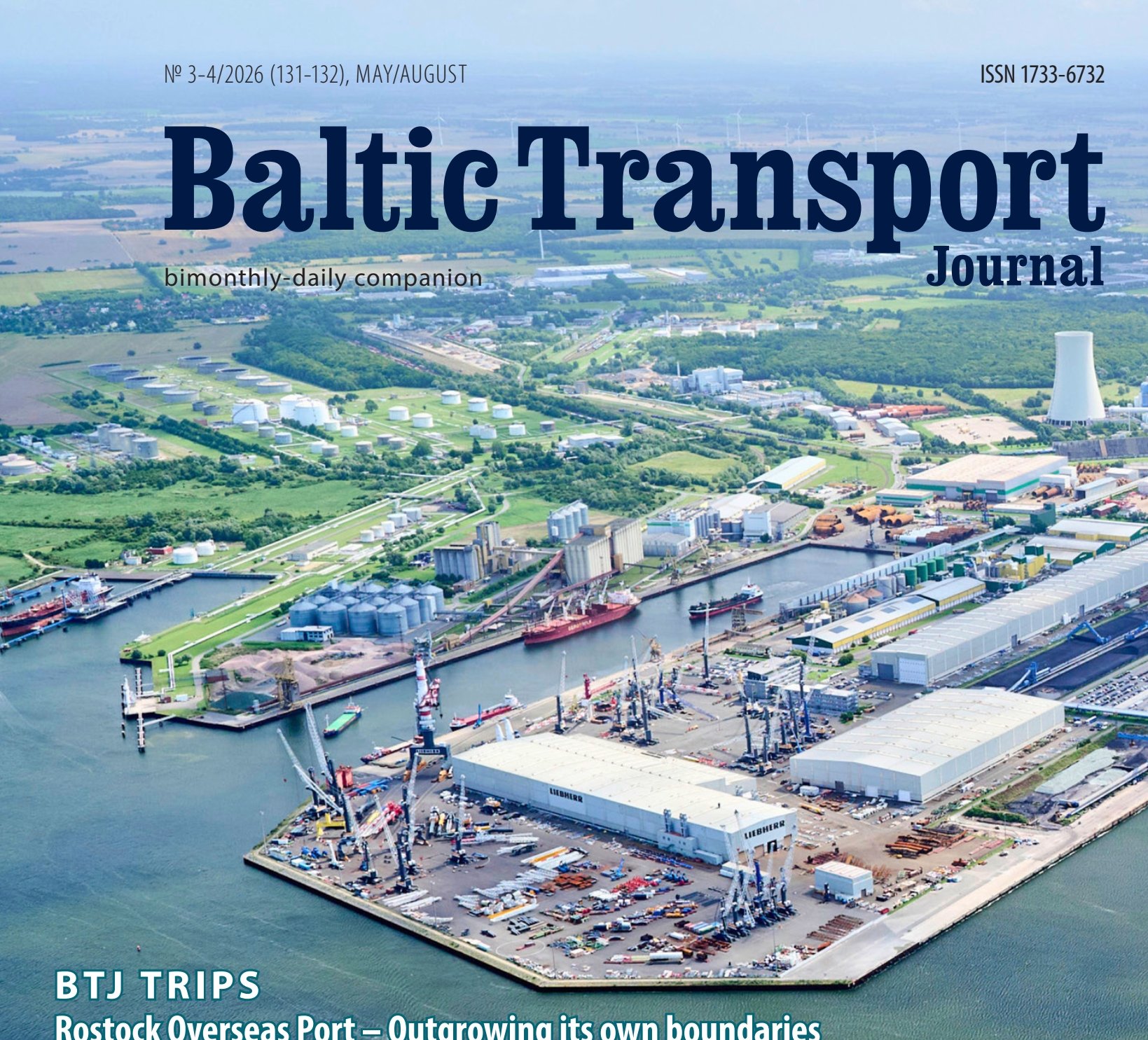
Our 2026 trip season began on the German Baltic coast – in Rostock. Though the settlement dates back to the 1100s, joined the Hanseatic League in 1251, and thrived as a vibrant seaport already in the 14th century, what we know today as Rostock Overseas Port has its roots in 1960. Nowadays, it’s the country’s largest Baltic freight port, handling all types of goods – dry and liquid bulk, unitised and non-unitised general cargo – and serving as a major passenger hub for ferries and cruisers. The port continues to evolve, notably repurposing its original 1960s dry-bulk pier into a vehicle terminal. But there’s far more to Rostock than just ‘infrastructure recycling.’ Handling wind energy components, that modern golden-goose business for ports? Check! Being home to one of the world’s best-selling cargo handling equipment manufacturers? Check! Eyeing future fuels? That’s on the drawing board, too!
We reached Rostock by train on 28 May after the TOC Europe trade fair, which this year moved to Hamburg after several editions held in Rotterdam. Though the weather on Friday the 29th was rather hazy, Maike Grunwald, responsible for Corporate Communications at Rostock Port Company (the landlord of the Overseas Port), greeted us more than warmly at the doorstep of the head office. We then hopped into a car for a unique guided ride throughout much of the seaport.
The grain harbour was our first destination. With over 2.4 million tonnes of various cereals and some 600,000-700,000 additional tonnes of ‘other substances of vegetable origin’ (according to the parlance of the German statistical office), it’s one of the biggest in the Baltic and one of Germany’s main grain export gates (with Africa, Central Europe, and Scandinavia being the chief receiving markets). Upon arrival, we saw the towering grain silos, able to accommodate up to 700,000 cubic metres at any given time. Processing also takes place on site, e.g., of barley for brewing or oil production. The latter we could actually scent (an intriguing mix of cabbage and nuts). Interestingly, it’s the only oil mill in Germany
operating ‘round the clock, with output ranging from canola oil to animal feed and bio petrol. On our way again, we also talked about the energy harbour (off-limits due to its strategic importance). Following Russia’s ongoing war of aggression against Ukraine, the pipeline feeding the PCK refinery in Schwedt went offline. As a result, Rostock started handling a lot more crude oil – around 6.0 million tonnes per year (another two million is transported to Schwedt via PERN’s pipe from the Northern Port in Gdańsk). Talking about energy, Maike showed us what ‘Made in Rostock’ wind energy looks like. EEW Special Pipe Constructions has been putting together monopiles since its establishment in Rostock in 2008 (with local production capacity of over 100 m-piles per year across the 32,000-square-metre facility; each structure can be 120-metre long and weigh 2,500 tonnes). The paradox is that EEW needs extra space to keep the momentum; otherwise, the business is at risk of leaving the seaport (and with it its revenues, not to mention around a thousand employees). Available space was a topic we also discussed later.
The next stop was the biggest employer within Rostock Port (and one of our journal’s long-standing partners): Liebherr Maritime Cranes (headcount of around 2,000). In addition to the production facility and offices, the site boasts its own academy (during TOC, we also visited the Liebherr site in Hamburg for the official launch of the Digital Solutions Campus). The other day, Liebherr approached the port operator, inquiring whether there would be 24 hectares for a heavy-duty industrial establishment. “No, not quite that much…” Maike confided. “But we ‘just’ quickly prolonged the pier by land reclamation – and did it twice,” she added as if it was a thing one does casually. The pier was extended and commissioned in 2004 and 2012. Maike also shared another ‘Bob’s-your-uncle’ story. On another occasion, it was Liebherr that was approached by an offshore business, which needed to fix one of its vessels with an exceptionally huge crane. The issue was that there was no gantry strong enough to mount that crane. Enter centre stage TCC 78000, a 5,500-tonne heavy land-mark titan that can lift to 1,600 tonnes (at a hoist of 36 metres; 1,000t/52 m, 586t/75 m, and 250t/99 m). As the ride continued, we saw a naval base sitting vis-à-vis the commercial part of the seaport. It is NATO’s new Combined Task Force Baltic headquarters, officially opened in October 2024, hosting the Quadriga exercise the following year. For something less threatening, we focused our attention on the cruise terminal. In high season, there are three berthing spaces available, and the longest cruiser that can visit Rostock is 330 metres long. The seaport is one of the Baltic’s prime destinations, with 592,000 guests welcomed in 2025 (some 60,000 more than in 2024). Two of the three Warnemünde berths provide onshore power supply (OPS). The 20MVA facility was completed in the summer of 2020 and back then was Europe’s strongest cold-ironing station for cruisers. The OPS is of modular design, with the components stacked inside twenty-foot containers, and the cable carriers are mobile to fit the dimensions of different vessels. Maike shared that about five in 10 cruise ships ‘plug in.’ Staying on the passenger topic, we next saw one of Scandlines’ hybrid Flettner-rotor-equipped ferries that ply between Rostock and Gedser. Each year, some two million ferry passengers go through Rostock’s gangways, on their way not only to and from Denmark but also Lithuania and Sweden (aboard TT-Line and Stena Line, the latter operating a rail ferry to Trelleborg, the last such one between Germany and Sweden). In connection with that, we also saw the 80,000-square-metre intermodal terminal, equipped with two 45-tonne lifting-capacity portal gantries that serve five tracks (recently upgraded to take care of 680-metre sets). Rostock handles 49 intermodal trains per week, both international (to Bratislava, Oradea, Padua, and Verona) and domestic (Dresden, Halle, Herne, and Karlsruhe). Of the over half a million ro-ro cargo units that passed Rostock’s quays in 2025, around 110,000 went through theintermodal facility. Apart from the above ferry services, the German Baltic seaport also serves pure ro-ro connections – to and from Hanko, Kotka, and Rauma (with loads of paper products). Car carriers link Rostock with the Norwegian Drammen as well as Halmstad and Södertälje in the Swedish Baltic.
But that doesn’t exhaust the wheeled cargo topic in Rostock. Since 2022, Autolink has been operating a vehicle terminal that spans over 70,000 square metres, including two 600-metre-long rail sidings. Vessel berthing takes place at one of those very first quays that were launched in the 1960s (rebuilt in 2020). The company hit the jackpot at the onset of the business, growing from 32,000 in 2023 to a quarter of a million (export) cars in 2024-25 (and to be precise, it specialises in taking care of high-end electric vehicles, including Teslas). We moved on and, after a short drive, saw in the distance what distinguishes Rostock, namely the fish port. Not that cutters are some otherworldly sight, but in the sense that it
constitutes a separate entity from Rostock Port. The same holds for Yara Port, an independent harbour belonging to the Norwegian chemical company. That sometimes makes it a bit confusing when sourcing statistics for our Baltic Yearbook. For Yara, this is quite simple: some 800,000 tonnes in 2024 and more or less the same volume last year. For the fish port, the official statistical office says 499 tonnes of ‘fish and other fishing products’ in 2025 (but there’s also the ‘products of agriculture, hunting, forestry, fishing’ category, with almost 2.59 million tonnes last year). To complicate matters further, a cargo harbour, too, rests outside Rostock Port. Altogether, the three ‘outsiders’ handled approximately 1.80 million
tonnes in 2025, according to the port operator. On the way back to the head office, we talked with Maike about Rostock’s developmental plans. Though with its 750 hectares Rostock Port is the largest German seaport on the Baltic coast, that land is almost fully utilised. To grow, it needs to move outside its current premises. There is space for doing that, but it’s all natural land, hence the sometimes emotionally loaded ‘trees vs industry/employment/revenue’ argument. Rostock is already Mecklenburg-Western Pomerania’s biggest industrial hot-spot and would like to leverage that position to attract new future-oriented businesses. In the past couple of years, there were talks of either starting up green ammonia
production on the site or becoming an import port for it to supply Germany’s energy transition with ammonia-derived hydrogen. Such developments require infrastructure, which in turn necessitates land. The Regional Spatial Development Plan is under revision, with Rostock Port hoping to secure additional hectares before long. The port operator is willing to compensate for the losses in nature – as it already does by investing millions of euros in wetland
restoration. Meanwhile, there’s a dredging project to deepen one tanker berth in the oil harbour to 16.5 metres. Though the port tour concluded, the BTJ Trip Rostock was far from over. Maike invited us to the port’s canteen for lunch ahead
of meeting the port operator’s managing directors, Dr Gernot Tesch and Jens A. Scharner, for an interview. As always, it was pure pleasure to ‘touch and feel’ a seaport from the inside. Vielen Dank und viel Glück!
Weiter zur Online-Ausgabe: Baltic Transport Journal